
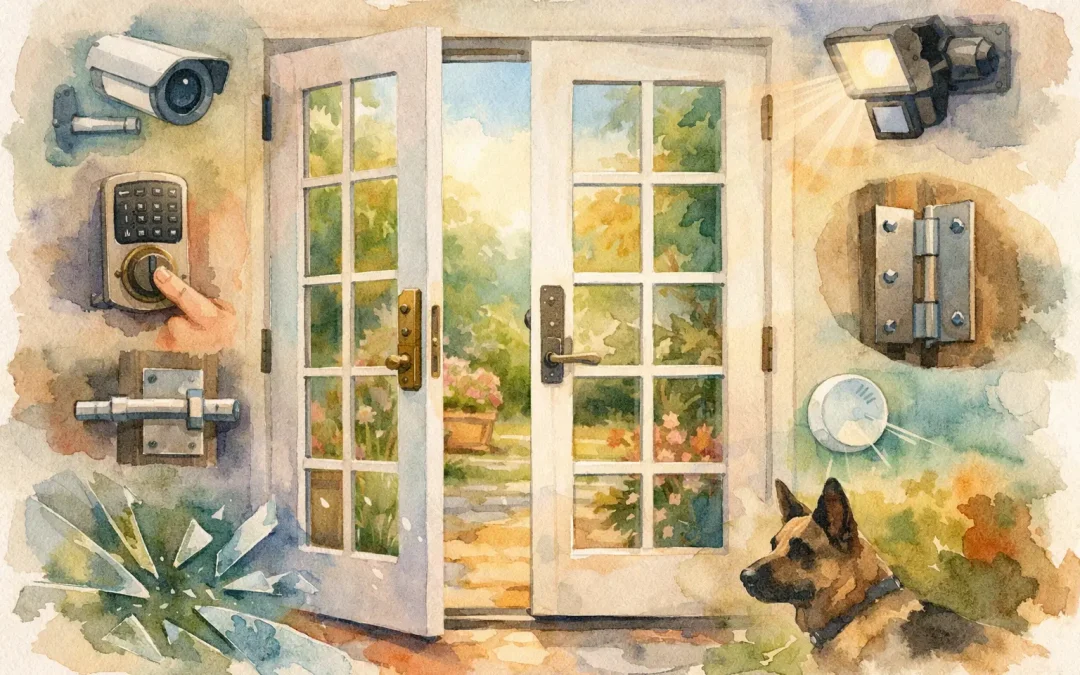
French doors bring welcome light and garden access, but their centre opening means French door security needs more thought than a standard single back door. The right door, correctly fitted and properly maintained, should feel solid, close cleanly and give you confidence when the house is empty or everyone has gone to bed.
The good news is that most weak points can be identified without guesswork. A loose handle, a stiff locking action, a visible gap around the frame or dated hardware are all reasons to take a closer look. Some issues can be repaired, while older or damaged doors may be better replaced with a made-to-measure, secure modern system.
Start with the doors and frame
Security starts with the structure, not an extra bolt fitted after the fact. Both door leaves should sit squarely in the frame, with even gaps around the edges and no movement when pushed or pulled. If one leaf has dropped, the locking points may no longer line up with their keeps. This can make the doors easier to force and can also put unnecessary strain on the lock.
Check the frame carefully, particularly on older timber doors and early uPVC installations. Rot, cracks, warped sections and loose fixings reduce the strength of the whole opening. A quality replacement door is only as secure as the frame it sits in, so installation matters just as much as the product chosen.
For uPVC French doors, look for a reinforced frame and sash, rather than relying on plastic sections alone. Composite French doors can offer an especially solid feel, but they still need suitable locks, hinges and professional fitting. The best option depends on the size of the opening, the style of your property and whether the doors are used daily or mainly as a garden feature.
Choose locks that protect both door leaves
French doors commonly use a master door that opens first and a secondary door secured by flush bolts. Both parts need to be locked properly. If the secondary leaf is held only by weak or poorly fitted bolts, the central meeting point can become the obvious weak spot.
A modern multi-point locking system secures the main door at several positions along its edge. When the handle is lifted and the key turned, hooks, rollers, bolts or mushroom cams engage with the frame. This spreads force across the door rather than concentrating it at one lock point. It also helps the door seal more evenly against wind and rain.
On doors with a euro cylinder, an anti-snap cylinder is a sensible upgrade where compatible. Quality cylinders are designed to resist common forced-entry methods and are available with recognised security ratings. The cylinder should sit correctly in the handle and not project excessively beyond it, as an exposed cylinder is easier to grip.
Avoid assuming that any new-looking handle means the lock is secure. Handles and cylinders work as part of one system, and worn internal components can stop a multi-point lock operating as intended. If you have to lift the handle hard, turn the key twice or shoulder the door to lock it, arrange an inspection before the mechanism fails completely.
Think carefully about thumbturns
A thumbturn cylinder can be convenient for quick exit, particularly where a door may be needed as an escape route. However, if there is glazing close enough for someone to reach the thumbturn after breaking a pane, a key-operated cylinder may offer greater protection. This is not a one-size-fits-all choice. The layout of the doors, the type of glass and safe escape from the home all need to be considered together.
Do not overlook hinges and the centre joint
Locks get most of the attention, yet hinges and the meeting stile deserve the same care. Outward-opening French doors need security hinges or hinge bolts to prevent the door leaf being lifted away if the hinge pins are attacked. Inward-opening doors still benefit from strong, well-fixed hinges that cannot be easily loosened or forced.
The central join should close tightly, with the inactive leaf firmly held by top and bottom bolts into the frame or threshold. Flush bolts that are bent, loose or difficult to operate should be repaired or replaced. Never rely on the master door lock alone to hold two door leaves together.
If your doors have a gap large enough to see daylight, rattle noticeably in the wind or flex when pressure is applied, adjustment may be possible. Worn hinges, loose keeps and misaligned doors are common after years of use. Leaving the problem can turn a straightforward repair into a new lock, hinge or door requirement.
Use secure glazing and protect nearby access
Glazing is one of the main attractions of French doors, so it needs to be treated as part of the security plan. Modern double-glazed units can use toughened or laminated safety glass, depending on the door design and location. Laminated glass holds together when broken, making it harder to create an opening quickly, while toughened glass breaks into small pieces for safety. A local door specialist can advise which option is suitable for your particular doors.
Do not forget the panels beside or above the doors. A secure main door can be undermined by a weak glazed side panel within easy reach of the internal handle. Equally, keep keys out of sight and away from the door. A key hanging on a nearby hook is convenient, but it may be reachable through broken glass or an open letterbox elsewhere in the property.
External lighting is another practical deterrent. A well-lit patio, side passage or garden path makes it harder for someone to work unseen around the doors. Choose lighting that covers the approach without shining directly into bedrooms or disturbing neighbours. A visible alarm box, door contact sensor or camera can add reassurance, but these are additions to sound physical security, not replacements for it.
Make French door security part of regular maintenance
Doors that are difficult to lock are often telling you something useful. Dirt in the track, damaged weather seals, seasonal movement and dropped hinges can all affect alignment. Clean the frame and threshold regularly, clear debris from drainage holes and use an appropriate light lubricant on moving metal parts where the manufacturer allows it. Do not force a stiff handle, as this can damage the gearbox inside the door.
At least twice a year, test the doors from inside and outside. Check that the handle lifts smoothly, the key turns without sticking and every locking point engages fully. Look for worn seals, cracked glass, loose handles and movement around the frame. It is also worth checking that the secondary door bolts go fully into their sockets and are not blocked by dirt or a raised threshold.
A change in how the doors operate should be dealt with promptly. In Leicestershire, periods of heavy rain, cold weather and summer heat can all expose faults in ageing doors and frames. Early adjustment or repair is usually more affordable than waiting until the lock jams or water begins entering the home.
When replacement is the better value option
There is no need to replace a sound set of French doors simply to improve security. New cylinders, handles, hinges, glazing units or lock repairs can often make a real difference. However, replacement is usually worth considering when the frame is damaged, the doors have repeated alignment problems, the locking system is obsolete, or draughts and water ingress are becoming regular issues.
A modern uPVC or composite French door set can combine multi-point locking, reinforced sections, energy-efficient glazing and a closer, more secure fit. Made-to-measure installation is particularly valuable in older homes, where openings are not always perfectly square. A door that looks attractive but does not fit correctly will not deliver the security, warmth or weather protection you are paying for.
For homeowners in Ibstock, Coalville, Ashby and the wider Leicestershire area, Supreme Home Improvements can assess whether your French doors need a practical repair or a secure replacement. A straightforward survey gives you a clearer picture of the condition of the locks, hinges, glazing and frame, so you can spend money where it will make the most difference.
A secure French door should never be difficult to use. If yours rattles, sticks, drops or no longer locks with confidence, dealing with it now can protect your home and save a more expensive problem later.