
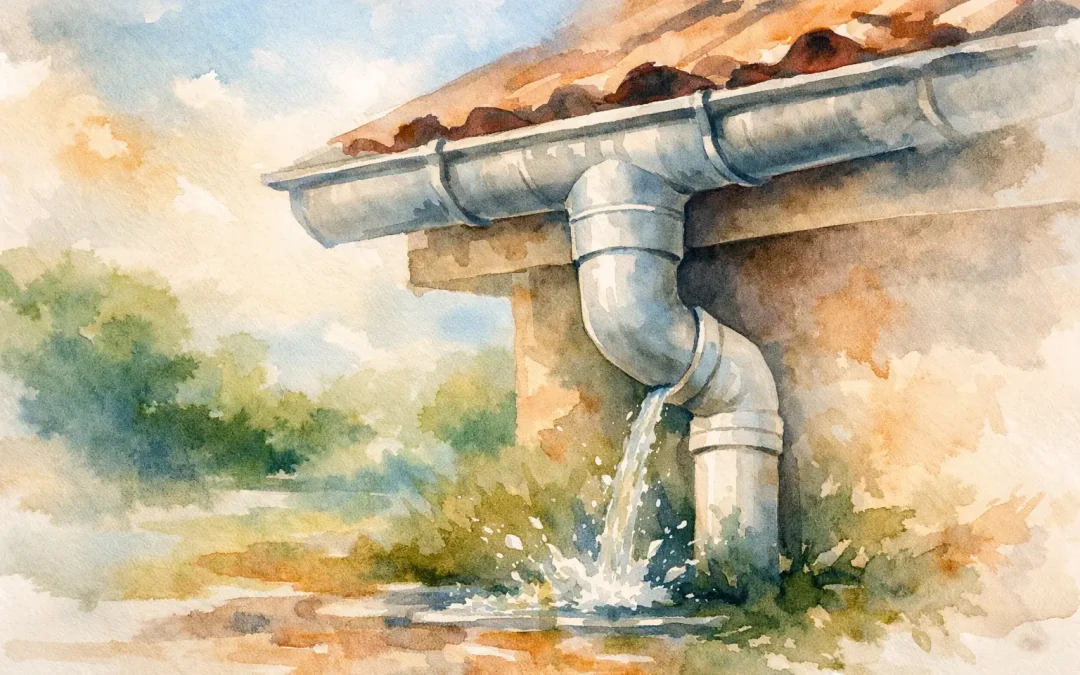
A gutter can look perfectly serviceable until a heavy Leicestershire downpour sends water spilling over the edge. Correct gutter downpipe sizing is what allows your roofline to carry that water safely away from the walls, windows, foundations and paths around your home. Get it wrong and even new guttering can overflow, stain brickwork and contribute to damp problems.
For most homes, the answer is not simply to fit the largest downpipe available. The right arrangement depends on the size and shape of the roof, the gutter profile, the number of outlets and how water moves across the roof during heavy rain. A proper assessment gives you a system that performs when it matters, without paying for unnecessary work.
Why gutter downpipe sizing matters
Gutters collect rainwater running from the roof. Downpipes then take it from the gutter outlet to a suitable drain or soakaway. If a downpipe is too small, there are too few of them, or the gutter itself does not have enough capacity, water backs up at the outlet and overtops the gutter.
That overflow rarely falls harmlessly onto the garden. It often runs down fascias and soffits, tracks over exterior walls and splashes against the base of the property. Over time, this can leave green staining, damaged pointing, peeling paint and damp patches. It can also make entrances and patios slippery.
The roofline is designed to protect the building from the weather. Guttering, fascias, soffits and downpipes need to work together. Replacing only one part without considering the whole system can leave an underlying drainage issue unresolved.
What determines the right downpipe size?
The main consideration is the amount of roof water draining towards each outlet. Larger roof sections collect more water, but roof layout matters just as much. A simple rectangular roof may drain evenly to two ends, while an extension, dormer, valley or conservatory roof can send a large volume to one short length of gutter.
Rainfall intensity is another factor. British weather can change quickly, and short, heavy bursts can test a system far more than steady rain. Guttering should be planned for peak conditions rather than the gentle showers it copes with most of the year.
The gutter profile also affects capacity. A deep-flow gutter can carry more water than a standard half-round profile of a similar width. This can be useful where a larger gutter is more practical or visually suitable than adding another downpipe. However, a high-capacity gutter still needs outlets and pipes capable of clearing the water away.
Finally, check where the downpipe will discharge. A correctly sized pipe is of little use if the underground gully is blocked, the drain cannot cope, or the outlet empties too close to the wall. The full route for rainwater needs attention.
Common sizes on UK homes
Many standard domestic installations use a 112mm half-round gutter with a 68mm round downpipe, or a 65mm square downpipe. These are widely used on ordinary houses and can work well when the roof area and outlet positions are suitable.
Larger homes, steep roofs, long gutter runs and areas where several roof slopes meet may need deeper guttering, wider outlets, larger pipes or additional downpipes. Different manufacturers publish different capacity figures for their profiles, so it is sensible to use compatible components from one system and base the decision on the product specification rather than size alone.
A 68mm downpipe is not automatically inadequate, nor is a larger pipe automatically the best solution. Capacity comes from the combination of gutter shape, fall, outlets, pipe size and the roof area served.
When one downpipe is not enough
Adding an extra downpipe can be a practical solution where water travels too far along the gutter before reaching an outlet. Long runs are more likely to struggle in a storm, especially if the gutter has only a slight fall or receives water from a valley.
Extra outlets are often worth considering on extensions, conservatories, garages and roofs with awkward layouts. They reduce the amount of water each outlet has to handle and provide a more direct route to the drain. The trade-off is that a second downpipe needs a suitable discharge point. It should not simply be left to pour across a path or against the property.
Where there is no convenient drain, a properly designed soakaway may be an option, subject to the ground conditions and the location of the property. This is something to assess carefully rather than treating it as a quick fix.
Signs your gutters may be undersized
Overflow does not always mean the guttering needs replacing. A blockage, slipped joint or incorrect fall can create exactly the same symptoms. Still, these signs suggest the system should be checked as a whole:
- Water spills over in heavy rain even after the gutters have been cleared.
- The overflow happens near an outlet or where two roof sections meet.
- One downpipe regularly gushes while the rest of the system stays relatively quiet.
- Exterior walls show repeated staining beneath the gutter line.
- Gutters hold standing water or sag between the brackets.
A quick visual inspection during rainfall can be revealing, provided it is safe to do so from ground level. Watch where the water first starts to build up. If it gathers at one outlet, the pipe or outlet may be restricted. If it overtops along a long section, the gutter capacity, fall or number of downpipes may need attention.
Do not overlook gutter fall and maintenance
Even correctly sized components will not work properly if the gutter is fitted without the right fall. Gutters need a gradual slope towards the outlet so water does not sit in the run. Too little fall allows debris to settle and can slow drainage. Too much can make the gutter look uneven and may reduce its useful capacity at one end.
Leaves, moss from the roof, bird nests and loose roofing material can quickly restrict an outlet. This is particularly common around trees and after windy weather. Regular cleaning helps, but it is not a substitute for a system designed to handle the roof area.
It is also worth checking the brackets and joints. A sagging length of gutter creates a low point where water and debris collect. Dripping joints can be mistaken for overflow, while a downpipe joint that has come loose may send water behind cladding or onto the wall.
Choosing a practical solution for your home
For a straightforward replacement, matching the existing gutter and downpipe sizes may be appropriate if the old system has performed well and its outlets are correctly positioned. If it has regularly overflowed, though, replacing like for like could mean paying for the same problem twice.
A good installer will look at the roof plan, measure the gutter runs, identify valleys and high-flow areas, and inspect the drainage points before recommending a solution. In some cases, clearing and re-aligning the existing system is enough. In others, a deeper-flow gutter or an additional downpipe gives much better protection.
Colour and finish matter too. Modern uPVC guttering is available in black, white, brown, anthracite grey and other finishes to complement windows, doors and fascias. The appearance should suit the property, but performance comes first. A neat roofline that overflows in every storm is not doing its job.
When to call a local roofline specialist
If water is running down the walls, you can see damaged fascias, or gutters overflow despite cleaning, arrange an inspection before the problem reaches the interior of the home. This is especially worthwhile before autumn and winter, when blocked gutters and persistent rain can expose weak points quickly.
For homeowners across Ibstock, Coalville, Ashby and the wider Leicestershire area, Supreme Home Improvements can assess guttering, fascias, soffits and downpipes as one complete roofline system. With more than 30 years in the trade, the focus is on a practical recommendation that suits the property and budget, not a one-size-fits-all replacement.
The best rainwater system is the one you barely notice: it sits neatly along the roofline, clears water quickly and keeps it away from the home year after year. If yours is struggling when the rain arrives, sorting the cause now can prevent a much more expensive repair later.